On paper, Pony Express Record by Shudder to Think ought to be an album I adore. It has complex rhythms, angular melodies, dissonant riffs and lots of distortion. It even arrived at time in my life when modern classical music started occupying my wheelhouse.
But for many years, I could muster at most an intellectual appreciation for the album. Something about it prevented me from internalizing it the same I would music by, say, Wayne Horvitz or Meredith Monk.
Part of the problem was the fact I never paid for it — Pony Express Record was an assignment for the student newspaper. I listened to the promo and found the album had potential. Because I didn’t discover it the way I did with Jayne Cortez or Bang on a Can, I didn’t feel invested in my opinion.
And because I was a snob where avant-garde music was concerned, I couldn’t take Shudder to Think too seriously. Just what were their bona fides anyway?
That ambivalence meant Pony Express Record would not survive a purge for cash. I don’t even know at what point it left my collection.
But it has always nagged at me. I felt I was missing something about that album, something that made it difficult to dismiss.
I’ve tried at different times after subscribing to Google Play Music to give Pony Express Record another shake, but my attention would drift, and it would end without my realizing I had it been playing.
When I spotted a copy at Lifelong Thrift Store for $1, I welcomed it back into my collection, and I gave it the attention I couldn’t afford it in the past.
As it turns out, my inability to embrace Pony Express Record comes down to my tolerance for odd, angular music — which is pretty high. For all its weirdness, Pony Express Record sounds quite normal to me.
I call this my Beck affect. When Beck released Odelay, critics couldn’t stop tripping over themselves to praise his whiplash cuts. I thought it was just poorly-executed John Zorn card pieces.
Pony Express Record is strange, but it’s not the strangest thing I’ve heard. It doesn’t stop it from being a good album, even an important one.
Shudder to Think made a loud, noisy album that relies on precise musicianship to pull off. Rather than dial up the metal influences of grunge the way nü metal bands would eventually do, the band made the punk influences veer into something a whole lot brainier. And they do it while throwing in an occasional hook over mountains of crunchy distortion.
I’m a lot more familiar with Pony Express Record now, and I’m OK with not being able to hum more than a few measures of “Hit Liquor.”
I joked with my mom that I didn’t want to travel anywhere in 2018 because I had gone to Victoria, BC and Salem, OR in 2017. Then I ended up going to Alexandria, VA in June and making a family visit to Honolulu in July.
Having lived in Austin, Seattle and New York City, I’ve noticed the health of a city’s music scene is reflected in the state of its record shops. By that measure, Honolulu is in passable health. The local shops dedicate significant shelf space to artists performing Hawaiian music, but since the scene itself doesn’t support much beyond that, Honolulu’s music retail options are limited.
That’s not to say you can’t find gems in Honolulu, but it usually takes a lot luck and some restrained expectations.
Hungry Ear Records
Hungry Ear had a prime location in Kailua, which it had to trade for a less-than-prime location near the University of Hawaii. It had to move again, this time to a far more spacious and pleasing spot in Kaka`ako.
As much as I miss the Kailua location, the Kaka`ako space is nice.
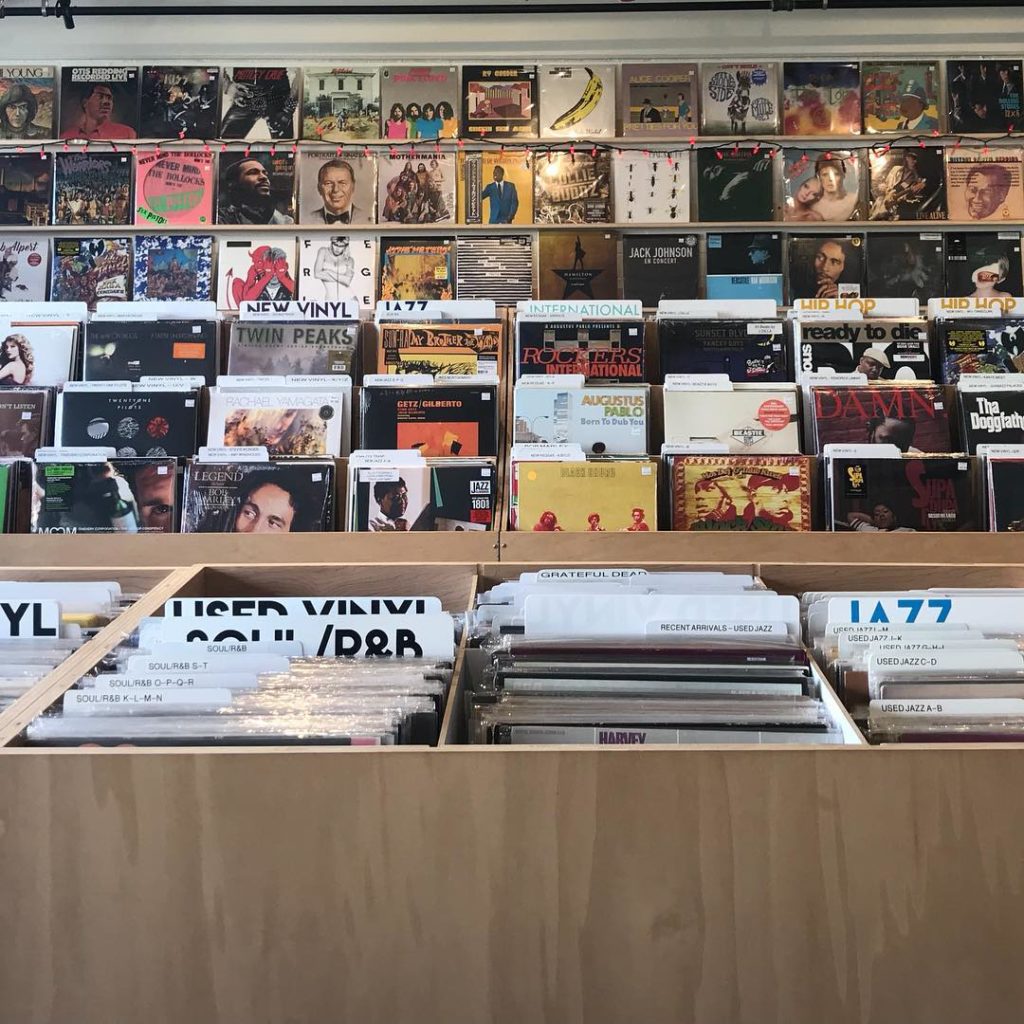
Hungry Ear has always been conscientious about organizing its stock well, and it’s a breeze to jump from genre to genre. Newly pressed issues take up a separate set of racks than used, and CDs form the perimeter.
Honolulu’s isolation means the stock is only as good as what happens to be on the island, but Hungry Ear somehow manages to find some winners, such as an original pressing of The Pogues’ Rum Sodomy & the Lash or a mid-80s reissue of McCoy Tyner’s The Real McCoy.
Idea’s Books and Music
On the day I visited Idea’s, a fellow customer asked whether the store was in the old location of Jelly’s Books and Music, not knowing he was posing to the question to the proprietor of both institutions.
Jelly’s has a long history in Honolulu. It flourished in the 1990s, then sold its locations to the Cheapo’s chain. It reopened again with locations in `Aiea and Kaka`ako, before downsizing again to a single location and rebranding as Idea’s.
Idea’s Books and Music is a far smaller operation than Jelly’s in its heyday, but the rustic charm is still in place. Idea’s stock reflects the taste of Honolulu in general, so it’s unlikely you’d find something esoteric.
But a bit of digging can uncover some surprises. On this last trip, I snagged an old rental copy of Tomosaka Rie’s Murasaki, a J-pop idol album renowned for including three early songs by Shiina Ringo.
Barnes and Noble
The compact disc boom of the 1990s allowed Honolulu to support three locations of Tower Records, two locations of Borders and the first Barnes and Noble location in Kahala Mall.
Today, a single Barnes and Noble store remains in Ala Moana Center.
The music section of Barnes and Noble has survived by adapting — first by including DVDs and Blu Ray, now by supporting vinyl.
The only time I’ve ever bought vinyl from Barnes and Noble in Seattle was for the exclusve release of Enya’s Dark Sky Island, but I make it a point to visit Barnes and Noble in Honolulu because of the difference in sales tax. In Seattle, it’s 10.1%. In Honolulu, 4.172%.
So I pretty much go to Barnes and Noble not for selection but for a 5.928% sales tax discount.
Book-Off
In the early 1990s, Shirokiya had its own music section. As the music industry fortunes turned, Shirokiya sub-leased the space to Book-Off. When Shirokiya relaunched as a food court, Book-Off moved to Don Quioxte. (Yes, there is a department store chain named after a Spanish novel, and it’s based in Japan.)
My friend Jen dislikes Book-Off because it makes terrible offers to people selling their books, and when I visited the Ward Warehouse location of Book-Off in 2016, the store was trying to sell fair- and poor-condition vinyl for upwards of $20. The Ward location was razed earlier this year.
So no, Book-Off isn’t the most reputable of retailers, but it was the place I could go to buy used Japanese rock and pop CDs.
Until this year.
I went to Don Quixote to find the CD stock completely replaced with Western artists. Honolulu no longer has a retail location that caters to J-Pop fans, a development that shouldn’t have been surprising given Kinokuniya’s move in the same direction.
A month into my new job, I traveled to Alexandria, VA to work in the main office of my company for a week. It marks the first time in a nearly-20-year web development career when I traveled for business.
Of course, I had to spend time checking out the record stores in the area. Most of the shops in Washington, DC are concentrated on U Street, which allowed me to hit a number of them in a single evening.
I left work at around 5 p.m. on a Tuesday and crammed as much shopping as I could before the stores closed at 7 p.m. My visit to Crooked Beats happened the day before.
Crooked Beat Records
Crooked Beat was the only shop not in DC proper, but in Alexandria itself, which made it my first destination. The DC area doesn’t have a square-footage behemoth like Amoeba, Waterloo or Everyday Music. So the shops are about equal in terms of size.
That said, Crooked Beat has a slightly bigger space than the rest of the places I visited, and it allowed me to find a good cross section of releases — some Nonesuch titles, Chris Isaak’s second album and a requisite helping of Fugazi.
I probably would have spent more time exploring if I hadn’t showed up about 45 minutes before the store closed.
Joint Custody
Joint Custody is comparable to Crooked Beat in terms of stock. Everything is organized by genre, and little else, so a lot of digging is required. I came away with an impulsive purchase of Kanye West — I don’t care for his politics, but The College Dropout stands above all that — and the self-titled Minor Threat compilation.
If time weren’t an issue, I probably would have explored further down the racks. Joint Custody’s space is longer than it is wide, and the back portion of the store included jackets and vintage turntables.
The Smiths’ The Queen Is Dead was playing in the background, which enhanced my shopping experience nicely.
Som Records
On the week I visited Alexandria, high temperatures reached the low- to mid-90s. And it was a humid heat.
Som Records is located in the basement of a building with little in the way of signage. On any other day, the cramped, un-air-conditioned space would be punk-rock charming. Not so much during a heat wave.
Despite the size, the stock in the store also spanned a wide swath of styles, and I even found another Nonesuch title from the mid-80s.
Smash Records
Smash Records is the punk-centric shop of the city. Getting there was a bit more of a hike, taking me away from U Street and into the Adams Morgan neighborhood. I saved it for my last destination because it closed at 9 p.m. From the hillside, you can see the Washington Monument.
Like Joint Custody, Smash Records has vintage wear as well as records in a space of similar size. The stock of new vinyl focuses mostly on punk, but its used selection has a diverse range of genres.
I rounded out my Fugazi collection with a purchase of Steady Diet of Nothing on CD. I nearly came away with Queen Latifah’s All Hail the Queen on vinyl, but it was in a sad state, priced accordingly.
Red Onion Records
Red Onion Records is a smaller space than Crooked Beats, which meant that the available stock didn’t happen to have anything in which I was interested. So my stay wasn’t long enough to form an impression.
A few titles didn’t get included in the last round-up of new releases, and the release schedule for late autumn hasn’t quite yet coalesced. So this list is thinner than I prefer.
Perfume, Future Pop, Aug. 15
We probably reached peak Perfume two albums ago, if the cool reception to COSMIC EXPLORER is any indication. Imaginative videos can’t quite make up for the weakness of the last few singles, but will either stop me from placing a pre-order? Unlikely.
Blood Orange, Negro Swan, Aug. 24
How did I miss news about a new album by Dev Hynes?
Oh, he announced it when my mom was in town and caught the flu, about a week before I would become briefly unemployed. Has it really been two years since the release of Freetown Sound?
Mandy Barnett, Strange Conversation, Sept. 21
I’ve Got a Right to Cry is a classic album that has been relegated to bargain bins and thrift store shelves. The Owen Bradley-produced album probably did too good of a job calling up the ghost of Patsy Cline, whom Barnett has portrayed on stage.
Barnett recently did a duet with Kenny Chesney, which … whatever. But I would still check out this album because I’ve Got a Right to Cry is an album that just doesn’t wear out, even after nearly two decades.
Jason Isbell and 400 Unit, Live from the Nyman, Oct. 19
It’s easy to marvel at how effortlessly it seems Jason Isbell spins his tales, but when he shreds on stage, it’s a sight to behold.
Fastball, All the Pain Money Can Buy (Deluxe Edition), Nov. 9
Oh, hey, it looks like part of my wish is coming true — All the Pain Money Can Buy is headed for a vinyl release, albeit saddled with bonus material for its 20th anniversary, which I’m pretty sure I’ll be getting anyway.
The strongest memory I have about this album involves one of my teachers in high school. At the time, I wouldn’t have admitted to thinking he was cute. Heck, I really didn’t know what was going on with my hormones to tell.
Compared with all the other teachers on the faculty, he was a kid, probably not more than 10 years older than I was. I didn’t really give age much nuance back then — he was an adult, so he fell under the broad stroke of old.
As a student, I never really liked raising my hand and asking for help. I perceived that as a sign of weakness. But on that first summer of high school, I was underwater. The school threw us into a geometry class that required Algebra I, and most of us hadn’t taken algebra.
So I had to ask for help. A lot. And I didn’t mind because, well, the teacher’s cologne smelled nice.
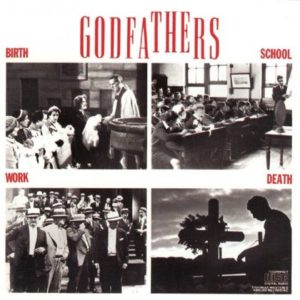
He was also building his music collection, and one of the albums he owned was Birth, School, Work, Death by The Godfathers. The album cover intrigued me, and it struck me as something I probably would like.
A friend of mine had picked it up based on said teacher’s recommendation and encouraged me to do so as well. I choose my purchases carefully back then, so I didn’t follow up.
Not for another 30 years.
I probably would have dug the Godfathers quite a bit. Birth, School, Work, Death has the reverb-drenched commercial sheen required of post-punk albums at the time, but it didn’t polish off all the rough edges from the band.
The Clash is an obvious influence, especially with the shouted choruses and Peter Coyne’s monotone verses. But that influence is tempered with a dash of classic rock and some well-timed melodies.
I hadn’t quite gotten into the rougher areas of punk, so the Godfathers would have been an appropriate gateway band.
Birth, School, Work, Death also has a cover that absolutely sells the album. If I had discovered the album by other means, I still would have found the austerity of the cover fascinating.
As it stands, Birth, School, Work, Death marks the first time my life ever resembled a song by The Police.